Ammonium Sulphate
White, odorless Ammonium Sulphate crystals or granules, readily soluble in water and widely used in fertilizer production and selected industrial processes. Common packaging: 50 kg/bag.
PRODUCT DETAILS
AMMONIUM SULPHATE 50KG – A RELIABLE SOURCE OF NITROGEN AND SULPHUR
Ammonium Sulphate, also known as Ammonium Sulfate, Sulphate of Ammonia, Diammonium Sulfate or SA fertilizer, is an inorganic salt with the chemical formula (NH₄)₂SO₄. It is commonly supplied as white crystals or granules, is odorless and readily soluble in water. The product is widely used in fertilizer production, industrial chemical processing, wood-based materials, microbial cultivation, fire-extinguishing powders, paper treatment, textiles and biotechnology.
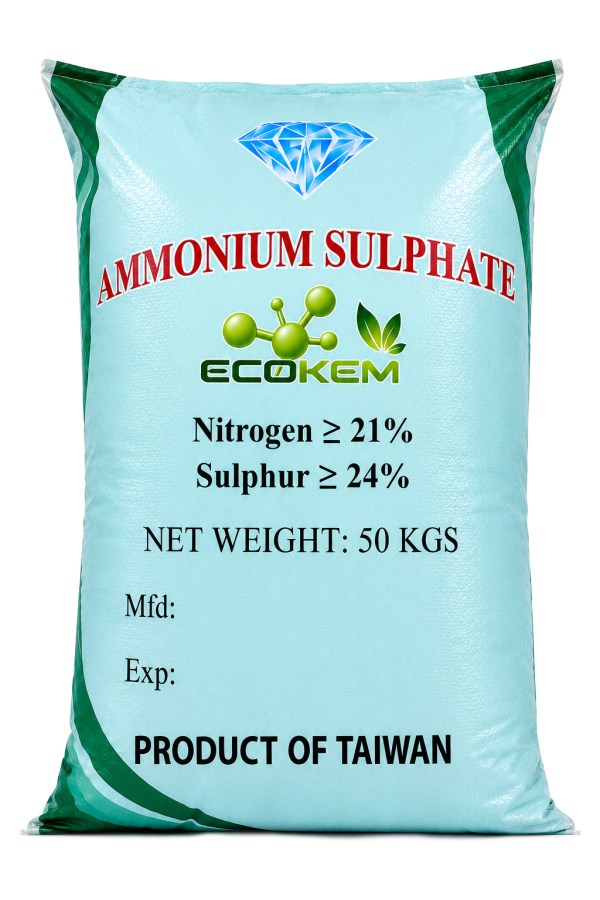
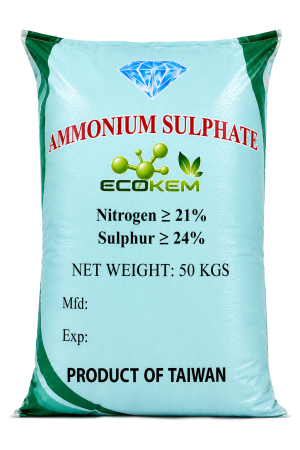
PRODUCT INFORMATION / Introduced packaging: 50 kg/bag. The product packaging displays Nitrogen ≥ 21% and Sulphur ≥ 24%. Final acceptance criteria must be verified against the Certificate of Analysis for the actual batch.
1. What Is Ammonium Sulphate?
Ammonium Sulphate is the ammonium salt of sulphuric acid. It consists of two ammonium ions, NH₄⁺, and one sulphate ion, SO₄²⁻. Commercial fertilizer grades commonly provide approximately 20–21% nitrogen and 23–24% sulphur. Ammonium nitrogen supports plant growth, while sulphur contributes to the synthesis of amino acids, proteins and enzymes.
2. Product Identification and Technical Data
| Property | Information |
|---|---|
| Product name | Ammonium Sulphate |
| Alternative spelling | Ammonium Sulfate |
| Common names | Sulphate of Ammonia, Diammonium Sulfate, SA fertilizer |
| Chemical formula | (NH₄)₂SO₄ |
| CAS No. | 7783-20-2 |
| EC No. | 231-984-1 |
| Molecular weight | 132.14 g/mol |
| Appearance | White or off-white crystals/granules |
| Odour | Odourless |
| Solubility | Readily soluble in water |
| Packaging | 50 kg/bag |
| Origin shown on packaging | Taiwan |
2.1. Typical Commercial Specifications
| Parameter | Typical reference |
|---|---|
| Total nitrogen | Approximately 20–21%; packaging displays ≥ 21% |
| Sulphur | Approximately 23–24%; packaging displays ≥ 24% |
| Moisture | Commonly ≤ 0.5–1.0%, depending on grade and manufacturer |
| Free acidity | According to manufacturer specifications and COA |
| Particle size | According to crystalline or granular grade |
| Water-insoluble matter | According to the batch COA |
| Flammability | Non-flammable under normal conditions |
| Stability | Stable when stored under dry conditions |
| Strong heating | May decompose and release hazardous gases |
TECHNICAL NOTICE / The values in this document are provided for reference only and do not replace the TDS, SDS or COA. Final acceptance must be based on the documents for the actual delivered batch.
3. Key Features
- Provides both ammonium nitrogen and sulphate sulphur.
- Readily soluble in water for suitable blending and solution-preparation processes.
- Solid form is convenient for weighing, transportation and storage when protected from moisture.
- Contains no added phosphorus or potassium, making it suitable for formulas requiring separate N and S sources.
- The 50 kg packaging is suitable for manufacturing, commercial distribution and industrial use.
4. Applications
4.1. Fertilizer Production and Blending
- Used as a source of nitrogen and sulphur for crops.
- Used in straight fertilizers, NPK blends and specialist fertilizer formulations.
- Adds sulphur to deficient soils and helps adjust nutrient formulas.
- May be applied directly under appropriate soil-test and agronomic recommendations.
- The product may be considered for rice, maize, sugarcane, coffee, tea, fruit trees, vegetables and industrial crops. Application rates should be based on crop type, growth stage, soil pH, irrigation conditions and the existing nutrient programme.
4.2. Industrial Applications
- Used as an ammonium source or intermediate in selected chemical processes.
- May support textile dyeing, fibre treatment and finishing processes after compatibility evaluation.
- Used in selected wood-material, paper, flame-retardant textile and fire-extinguishing powder formulations.
- May be used in specially designed water-treatment systems.
4.3. Laboratory and Biotechnology Applications
- Ammonium Sulphate of an appropriate purity grade may be used for protein precipitation by the “salting-out” method, microbial cultivation or fermentation. Fertilizer grade and general industrial grade must not automatically be used in laboratory, food, pharmaceutical or animal-feed applications.
5. Instructions for Use
- Apply directly to soil as a basal or top-dressing fertilizer according to the cultivation programme.
- Blend with compatible fertilizers.
- Dissolve for use in suitable systems or use as an industrial raw material.
- Perform compatibility and small-scale tests before blending or full-scale processing.
- A single dosage should not be applied to every crop and soil. Industrial users should evaluate the effect on pH, solubility, equipment and finished-product stability before large-scale use.
6. Safety, Storage and Transportation
- Wear safety goggles, gloves, protective clothing and dust protection during handling or transfer.
- Work in a well-ventilated area, minimise dust generation and avoid inhaling dust.
- Store in a dry, cool and ventilated warehouse; keep bags on pallets and away from direct floor contact.
- Keep packaging tightly closed and protect from rain, high humidity, direct sunlight and strong heat.
- Separate from alkalis, nitrites and incompatible chemicals.
- Do not discharge large quantities into drains, surface water or groundwater.
- Protect cargo from rain, secure the load and keep labels intact during transportation.
- In case of eye contact, rinse immediately with clean water for at least 15 minutes. If excessive dust is inhaled, move the affected person to fresh air. Seek medical attention if symptoms persist and provide the product Safety Data Sheet.
7. Selection and Acceptance Criteria
- Nitrogen content, sulphur content, moisture and free acidity.
- Appearance, particle-size uniformity and caking condition.
- Water-insoluble matter and application-specific impurity limits.
- Origin, manufacturer, packaging condition, COA and SDS.
- Suitability for the plant’s actual technical and process requirements.
8. Frequently Asked Questions
• Is Ammonium Sulphate the same as SA fertilizer?
Yes. SA fertilizer is a common agricultural name for Ammonium Sulphate.
• What is the chemical formula?
The formula is (NH₄)₂SO₄. The product has CAS Number 7783-20-2 and a molecular weight of 132.14 g/mol.
• How much nitrogen and sulphur does the product contain?
Common grades typically contain approximately 20–21% nitrogen and 23–24% sulphur. Official values must be confirmed by the batch COA.
• Is Ammonium Sulphate soluble in water?
Yes. It is readily soluble in water and is suitable for many blending and production processes.
• Can it reduce soil pH?
The conversion of ammonium nitrogen may gradually reduce soil pH. Soil pH should be monitored and application should follow agronomic guidance.
• Can it be mixed with lime?
It should not be mixed and stored for long periods with lime or alkaline materials without technical evaluation because ammonia may be released and nitrogen may be lost.
• Can industrial grade be used in food processing?
No. Only a properly certified grade that meets the legal and technical requirements for food use may be used.
• Why does the product form lumps?
High humidity, open packaging or contact with a damp floor may cause caking and reduced flowability.
3T CHEMICAL COMPANY LIMITED
Dear Valued Customers, are you looking for reliable chemical sourcing solutions?
Please contact 3T Chemical for consultation on suitable products, packaging specifications, COA/MSDS documentation, and appropriate delivery solutions.